The Curiosity Cabinet
is very excited that Masterpiece opens tonight! Here's a little sneak peak from
Apter Fredericks of just one fascinating object we'll be eyeing up at
London's best art, antiques and design fair. Our top five picks of the fair on
Art Wednesday are to follow....
A Regency Gilt & Patinated Bronze & Cut Glass Spirit Cask Celebrating Nelson’s Victory at the Nile. Numerous pieces of furniture, silver and
other forms of decorative art were made at this time to commemorate
Nelson’s victory at the Battle of the Nile. This example bears the
crocodile so closely linked with Nelson; his captains were referred to
as the ‘Crocodile
Club’, and along with the numerous nautical motifs, the armorial plates
and the quality of this cask, it is tempting to believe it might have
been made for the Crocodile Club or perhaps Horatio Nelson himself.
Japanese armour is compositionally complex in its intricate combining of metal and rope to create movable parts. These two materials were knotted and threaded together to form flexible articulations that provided the protective layer for Samurai going into battle. The armour was required to be strong enough to protect a body from sharp weapons yet supple enough to retain the sort of elasticity required for movement in battle. The joining of these perfectly measured components is a complicated balance that required technical craftsmanship of the most highly skilled. One of the most profound schools of armour makers, the Myochin school, also applied their metalworking expertise to bronze and iron figures.
Since the middle of the Edo Period (1600-1868), representational sculptures of animals and insects were made to inhabit the interior alcove where works of art were to be displayed - the tokonoma. Most exceptional of these representational animals are the jizai or articulated figures of animals. Perfected at the Myochin school, jizai are realistically shaped figures
of animals made from iron, copper, shibuichi (copper and silver alloy)
and shakudo (copper and gold alloy). They move like real animals, as their bodies and limbs are composed of metallic articulations. Their lithe and flexible bodies emulate the movement of actual animals and they are commonly found as birds, fish, snakes, lobsters, crabs, insects and dragons.
If you've ever wondered what it might feel like to hold a writhing, slithering snake in your own hands then these animals may very well come close to the actual experience. Their movement is so naturalistic it makes the material composition of metal almost implausible. Our favourite of these incredible figures are the impressive snakes below.
An Articulated Iron Snake, Myochin School, Edo Period (1750-1800), Victoria & Albert Museum
A Myochin-School Iron Articulated Model of a Snake, signed Muneyoshi, Meiji Period (late 19th century), lot 248, Sale 2596, Christie's South Kensington, 09 November 2011
This figures long, fully articulated body is made of russet iron and constructed of numerous hammered
plates joined inside the body. Its head is carved with naturalistic scales and a fitted hinged jaw, inside which is a movable tongue in gilt.
Sold for an impressive £21,875 against an auction estimate of £1,500 - 2,000 proves
these objects remain competitive finds amongst collectors. Similar examples sold in Christie's New
York 18th September 2007, Lot 188, and 23rd March 1999, Lot 133 (as below).
Set your scene with a fabulous screen. Whether you wish conceal or
reveal, add a little partition to your life with these scene stealers.
Prepare to divide and conquer...
A six-fold paper screen painted in ink and colour on a gold ground with ajisai (hydrangea)
Japan, Edo period,18th century
Hello Saturday! What a perfect day for
Curiosity Shop shopping. First stop, Gregg Baker Asian Art on Kensington Church St. They carry the largest stock of Japanese screens in Europe so if I'm to find the sumptuous, gold screen to sling my silk robe over then this is the place to be!
Screens
have historically evoked mystery. They can be used practically to
divide a large space or to conceal their owner while dressing
or undressing. Folding screens in Japan functioned both as a type of
furnishing and as decoration. Screens served to divide large open spaces
into more intimate and private areas, often for the purposes of
dressing or sleeping. The glimmering gold-leaf surfaces
characteristic of folding screens reflected ambient light and enlivened
the space with the pictorial scenes upon them. In outdoor settings,
screens could be arranged to function like portable walls, demarcating
space and shielding revelers from prying eyes.
James McNeill Whistler, La Princesse du Pays La Porcelaine, -
In
the eighteenth century screens came to Europe from the East, becoming a
glamorous status symbol indicating the vogue for an
Eastern aesthetic at this time. Only the upper echelons of society possessed these
dramatic space dividers.
James Tissot, Young Women Looking at Japanese Objects, c.1869-1870
In the nineteenth century, Japonisme, or a love of all things Japanese, was influencing aesthetic design from painters to furniture makers. Screens became more attainable from possessions of just the very rich, to objects for the aspiring middle classes.
This beautiful Japanese screen depicts morning glory flowers bursting across a gold-leaf surface. They rise and fall over the background as if suspended by nothing - denying any sense of space or a natural context from which they may have grown. This combination of naturalism and abstraction often appears in Japanese screens of this period and in this screen, the contrast is particularly marked.
A pair of six-fold paper screens, Japan, Edo Period (18th century)
Gregg Baker Asian Art
This pair of screens depict shkikishi or poem slips depicitng Sanjūrokusen (thirty six Immortal poets) and calligraphy above morning glory and clematis blossoms.
The occurence of the thirty six poets as a painting is based on an anthology of selected poems by Hujiwara no Kintō (996-1041). Here, each line of poem forms a patterned sequence of geometric strips which reverberate rhythmically across the surface.
A two-fold paper screen painted in ink on a gold ground withShochikubai (Three Friends of Winter), signed Bunchō hitsu; sealed Ga gakusai
Japan, Edo period (19th century)
Gregg Baker Asian Art
Shochikubai, the Three Friends of Winter is a motif of Chinese origin combining pine, bamboo and plum to symbolise winter and long life. The monochromatic black in this image emphasises winters bleakness in colour while the tonal variance of this one shade accentuates this visual coldness, contributing to the seasonal theme.
A six-fold paper screen painted in ink and colour on a gold ground with six individual botan(peony)
Japan, Edo period (18th century)
Gregg Baker Asian Art
My favourite of all flowers depicted in Japanese art, the peony incites a heady Eastern romanticism with its full petals and sweet scent.
A six-fold paper screen painted in ink and colour on a gold ground with summer flowers including botan (peony) in full bloom, satsuki (azalea) and fuji (wisteria) hanging from a bamboo trellis on the banks of a river amongst golden clouds. Japan, Edo period(18th century)
Gregg Baker Asian Art
Painted with
delicate precision on Edo period paper, a landscape of flowers provides a setting for opium dreams. Follow the silk road down a peony edged river toward golden clouds: you couldn't find a better scene than this to evoke the screens role of mystery and romance.
A six-panel Japanese screen, painted on paper of gold and silver mountain with clouds above. JAN Fine Art
In many layers of gold, an abstracted landscape demonstrates the very interesting combination of figuration and stylisation at play on Japanese screens.
A pair of two-fold paper screens painted in ink on a buff ground with abstract calligraphy which loosely translates as, 'From Morning to Evening (let your spirit) Soar'
Sealed Teruko
Japan, Meiji period (19th - 20th century)
Gregg Baker Asian Art
A Six-Fold Screen, Heisei Period (1990-1993) Lot 127, sale 7316, 07 November 2012, Christie's, South Kensington
This very large and dramatic modern screen sold at Christie's in November last year for £7,500. Considering its size (212cm x 380.5cm) and hence the quantity of gold-leaf, the price was surprisingly low. It is a multi-functional piece, acting as both functional furniture and contemporary art.
The bold contrast of contemporary calligraphy scribbled and splashed across a bright gold background enables this screen to become a striking and dramatic piece of art. Such drama brings an element of magic to an interior space. A screens
ability to divide and change a space becomes a theatrical act. It sets a scene that is dramatic and intriguing for both the screens role in a room and in the subject matter it may depict. This heady aura of mystery and intrigue allows fiction to overtake reality: who or what might reside behind the screen. As opium dreams seep in and jasmine nights take over, the voyeur steps in to play.
Teetering precariously on the fragile precipice that edges fine and decorative art, Josiah McElheny’s sculptures are at that complex and controversial point where a definition seems to waver and perhaps even fall to the revine below. In the upstairs gallery in his current show at White Cube, Mason’s Yard he fills vitrines with jagged glass sculptures that showcase his skills as both fine craftsman and accomplished contemporary artist.
Josiah McElheny, The Space Age
Body (after Cardin, Courrèges, and Gernreich), 2012
Josiah McElheny, The Uniform Body (After Popova and Rodchenko), 2012
As an expert glassblower, trained under the tutelage of European masters, he has ability to create the most the delicate and feather light sculptures, beautifully decorative by sight yet often connoting deeper, darker meanings. The reflective surface of glass, with its ability to let light through and in, does by no means allow the meaning to be less opaque. Blown from heated fire into works which look light as
air, McElheny has mastered this incredibly hard skill, blowing threads
of different coloured glass into each piece. The lined striations act
like light refractions which appear to move and undulate as you walk
around the sculpture.
By allowing the viewer to experience the sculptures differently from various angles, the human body becomes a key player in his works. The cabinets or vitrines are partly based on those that Carlo Scarpa designed to display
plaster models (at 25% scale) of the human figure in the Museo Canova in
Possagno, Italy, providing a contextual framework for which to view the glass forms.
The idea of the body is interpretable from various historical and cultural stand-points. For McElheny, the modernist perspective is directly referenced as each cut-glass form is based on designs
or templates by different twentieth century artists. The titles of his works make this explicit by providing an obvious cultural reference for which the viewer can interpret and view the works.
Interactions of the Abstract Body at White Cube, Mason's Yard
As his sculptures fit safely inside glass containers, do we really wish to try and define his work with such similar boxed parameters? Whether sculpture, craft, design or contemporary art, the most likely answer is perhaps proposed by the MacArthur Foundation, who gave McElheny a grant in 2006, stating his style of creation is a “new, multifaceted form of contemporary art.”
Interactions of the Abstract Body at White Cube, Mason's Yard until 12 January 2013.
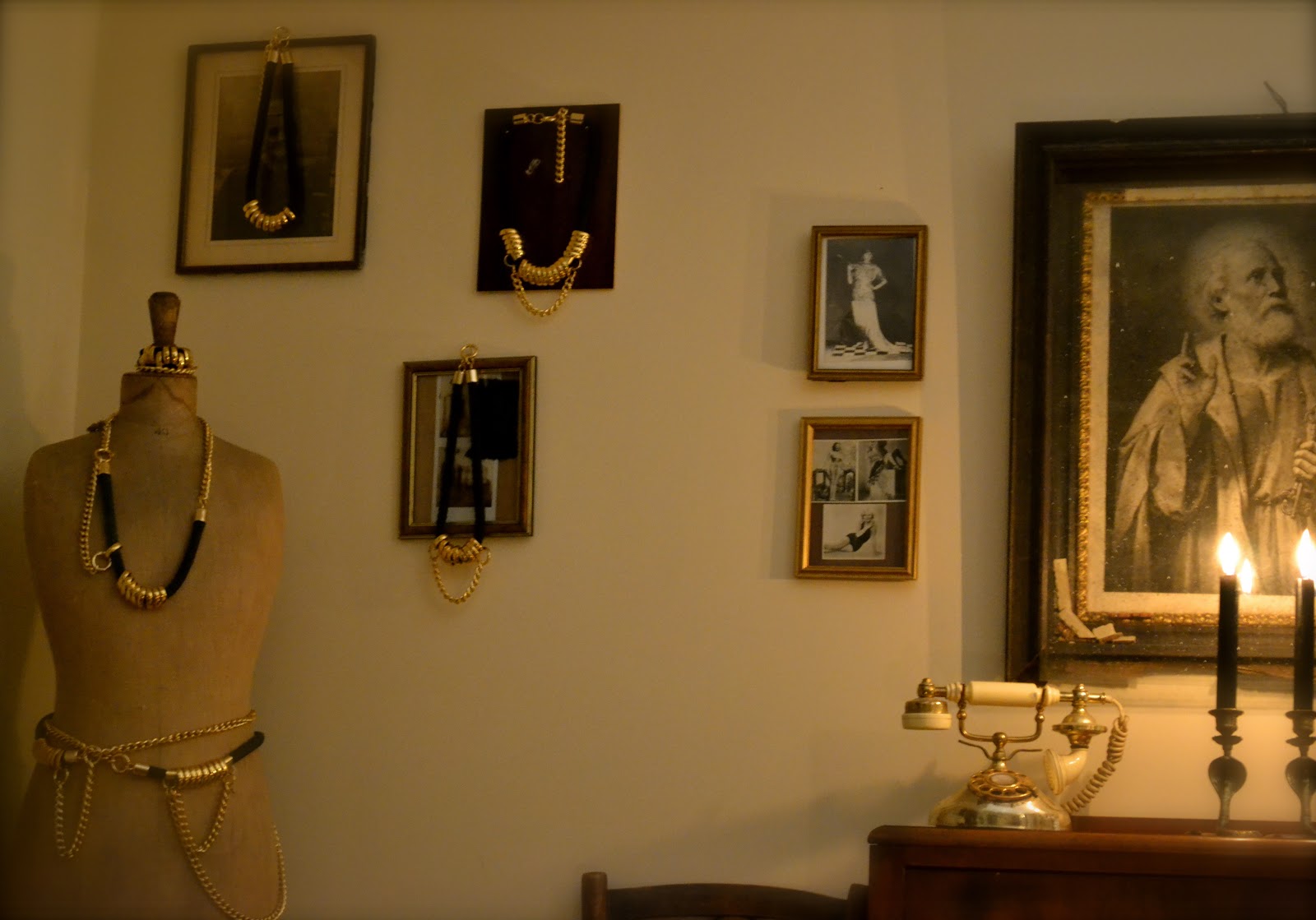
Last month, The Curiosity Cabinet collaborated with Helen Elizabeth Accessories to create the very first Magpie Boutique pop-up shop. An East London flat was transformed into a 1920s inspired boudoir boutique, showcasing the Rope-Collier collection of jewellery by fashion designer Helen Elizabeth Spencer. The lucky punters who attended also had first dibs at her limited-edition pieces which were strands of raspberry rope and shiny gold chain. The cosy, domestic setting was transformed into an exotic treasure chest for one night only - think feathers, lace, dimmed lights and chaise longues with a contemporary twist in keeping with Helen’s modern collection. Helen’s jewellery has a strong architectural, edge featuring chains and metal components which are softened by the textural, natural rope that holds the pieces together. They are very tactile by nature, in rich colours of black, raspberry, sea-green and blue. They are striking, modern pieces from chunky necklaces and bracelets to slinky belts which update any outfit from day to night. Both classic and contemporary, they have a certain je ne sais quoi which alludes to bondage. It must be that striking contrast of black and gold with their detachable chains and clasps…The Magpie Boutique certainly is a collaboration to keep you on your toes!
Look out for the next Magpie Boutique coming this year!
“In his blue gardens men and girls came and went like moths among the whisperings and the champagne and the stars.” F. Scott Fitzgerald, The Great Gatsby
Evoking old world glamour,
decadent garden parties and beautiful creatures shimmering like moths at
dusk, F. Scott Fitzgerald really knew how to pen the style of an era
the whose popularity has never waned. Through the swish of their damask,
the softness
of their velvet and the sparkle of their beaded gowns, the style of the
Jazz Age is deliciously imagined in the description of his characters
in The Great Gatsby. His novels call to mind the fashions of the Art
Deco era - motor cars, the Charleston, the Manhattan,
flappers and the geometric precision of Art Deco design - capturing the
very spirit of the era. In this hedonistic post-war period it felt,
especially in America, as if anything were possible.
If Gatsby’s words were to be illustrated, the Art Deco fashion
illustrations of this epoch would be fitting. More than just a sketch
for clothing, they transport you to the dazzling Jazz Age where
fashionable women take centre stage. These detailed drawings
of the latest fashions are contextualized in gardens and interiors
where the likes of Jay Gatsby himself might be found. The decadent and
flamboyant atmosphere of this time is magically construed by the use of
symbolic elements in the picture landscape. By
including interior objects, tassled lamps, statues, splendid gardens,
intricate bird cages, exotic birds, handsome men to dance with and women
lounging nonchalantly on chaise longues, to name a few, they become
portraits of an age as well as illustrations
for the famous fashion designers such as Poiret.
The colours and composition draw your attention to the central focus –
women’s dress. Turbans, long strings of sparkling beads, fabulous
patterns, and backless couture are intricately drawn within a flat, two
dimensional space. Outlined in black and peppered
with Eastern images, the taste for Asia is present in the imagery as
well implied by the outlines and the two dimensional style reminiscent
of 19th century Japanese woodblock prints.
Two of the most skilled illustrators of the era, Georges Lepape and George Barbier, produced the beautiful creations below.
Let these Parisian artists seduce you into the 1920s and decade preceding with champagne, garden parties and twinkling stars...
“So we beat on, boats against the current, borne back ceaselessly into the past.”
Illustration by Georges Lepape, circa 1910, of a Paul Poiret design
Illustration for Nijinsky’s Scheherazade, by Georges Lepape, 1910
Fashion plate from Journal des Dames et des Modes (1912-1914). No. 46
Pre-1900, before the sharp edges of Modernism simplified our consciousness, the world was steeped in a tradition of visual opulence. The Baroque and Rococo periods looked back to the classical age for ideal images of beauty and reinterpreted these in the most decorative of ways. They created a world that literally glittered in ostentation.
You only have to visit the Palace Versaille in the Paris sunshine to see a monument to ornamentation at its finest. At Versaille, the 18th century French aesthetic style transcends into otherworldly phenomenon. Just like the copious, gilt mounted furniture and objects that inhabit the interior, the palace itself is highlighted with tips of real gold, which make it shimmer and gleam in a most extraordinary way. Versaille is a prime example where the more extreme and lavish the display of ornamentation, the more power the monarchy seemed to portray. Religious ritual power and political autonomy seemed to shine out of the most elaborate monument to wealth the world had ever seen.
From Versaille's glittering exterior to the furniture within, gilt mounts (called Ormolu) adorned almost everything to create a powerful visual effect or éclat. As candlelight danced over such an 18th century interior, the gilt mounts and frames glowed with an enchanting golden reflection that lit up an entire room.
A fabulous example of a golden 18th century interior in London is the Wallace Collection pictured in the first image above and directly below. The Wallace Collection was established between about 1760 and 1880 by the first four Marquesses of Hertford and Sir Richard Wallace, the son of the 4th Marquess. They amassed an incredible collection of 18th century art and furniture which now exists as a public museum.
As trade between Europe and Asia boomed in the 18th century, porcelain and objects from the East became increasingly sought after. That these objects had travelled from far and distant lands made them all the more desireable.The vogue for Asian objects increased as people found their presence in interiors exotic and fascinating.
Ormolu mounts were added to porcelain and furniture to satisfy the Rococo taste for gilt and glitz. While the unusual beauty of these Eastern objects was appreciated, their aesthetic was essentially Europeanised to suit French taste.
This pair of of gilt-bronze-mounted Chinese celadon vases aux tritons, with mounts attributed to Pierre Gouthière (1732-1813) sold at the Sotheby'sTreasures, Princely Taste sale in London on 4 July 2012 well above their estimate of £150,000-300,000 for a staggering £577,250.
The combination of faultlessly crafted ormolu mounts and Chinese porcelain designed and painted to perfection makes them an incredibly rare and sought after pair.
Design for a Mounted Chinese Vase, ca. 1750-1785
Porcelain had an almost mythic quality in the 18th century. This was in part due to the secret recipe which the Chinese had hidden from the French for years. How porcelain was actually made and what it comprised had puzzled Europeans for centuries. Before discovering the chemical composition of porcelain there were many theories that proposed it evolved organically - it was even thought it may have been created from shells. Such notions were prevalent because for a long time after porcelain was manufactured in the late 6th century, China held the monopoly on its production. Its secret recipe provoked myth making to ensue. It was not until the 1760s that France discovered the essential component of porcelain, kaolin, which meant that true, hard-paste porcelain could be manufactured.
The recipe for porcelain manufacture was contained in the letters of the Jesuit priest Francois Xavier d'Entrecolles (1664-1741), who resided and worked at the Chinese centre for porcelain manufacture, Jingdezhen. After spying on the process he wrote letters back to France on accounts of Chinese ceramic practices.[1]
[1] These letters, written in in 1712 and 1722, were in turn published in Paris in 1717 and 1722 and were then incorporated in Jean Baptiste Du Halde's Description geographique de l'empire de la Chine,Paris, 1735.
This pair of Chinese porcelain vases with French gilt-bronze mounts, ca. 1740–50 can be found in the Metropolitan Museum of Art in New York. The typically Rococo mounts with scrolling fronds and central cartouches hide the fact that these blue-green celadon vases have been cut down and reduced before being mounted. The Chinese character shou, which means long life, is in low relief on their body.
Like the Met example above the watery, translucent glaze of this ewer from the Wallace Collection is contextualised in oceanic imagery as it was set in gilt-bronze mounts that are bulrushes, shells and algae - perhaps an allusion to the myths of porcelains organic origins that perpetuated in the 18th century.
In the 18th century it was popular to display such ewers en garniture. Garniture usually adorned chimney places and was typically produced in odd-numbered sets, as it was believed that this was most pleasing to the eye. Most commonly comprised of three items but sometimes sets of five, types of vessels included clocks, vases, pitchers or ewers, as well as urns.
The Queens Chamber, Versaille
Gilt-mounted porcelain was just one component that made up the Rococo interior. However, it remains one of the most intriguing adornments. The dual components of gilt-mounted porcelain, Eastern ceramics and Western gilt-bronze, make them visually complex and provocative objects. This geographical and material dichotomy enables them to provoke questions of place, belonging and even cultural power within the framework of 18th century decorative arts.